
Japanese Tea Ceremony & Its Relevance to the Martial Arts
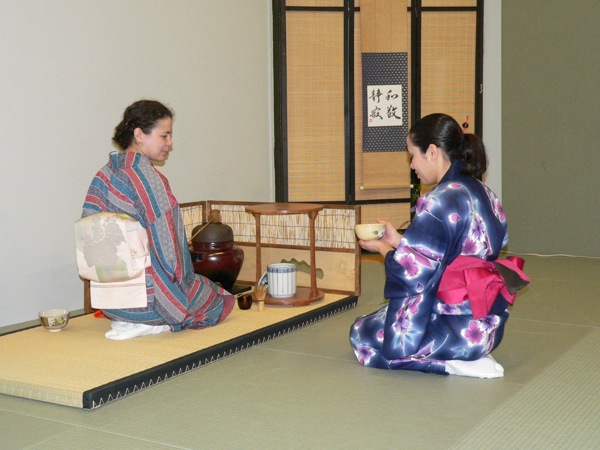
Sado, Japanese tea ceremony, is an art that has long been associated with the martial arts. Back in feudal Japan, it was initially indulged in primarily by the nobility. It was intended to be an activity free of social and political trappings, as guests were required to enter the tea room by a 2.5 square foot crawl door, a deliberately humbling device symbolically creating a sense of equality to everyone inside. The tea room was one of the few places in which a samurai was not allowed to carry their swords, leaving them outside as they enter.
Embracing Failure: The Value of Struggle When Learning Martial Arts
 A recent Time article called Why Floundering is Good I read suggests that trying to figure out something on your own produces better results than having guidance from the beginning. The article is written in the context of intellectual learning, but I do think there are some takeaways for people learning or teaching martial arts or other physical skills, even if some adjustments need to be made for practicality and safety.
Obviously you don’t want to let students practise martial arts techniques in a way that is unsafe to themselves or their partners. They may learn from the injury, but at the cost of their well-being and the ability to train, which is not a worthwhile trade-off. Once certain foundations are laid, however, and students are able to do the techniques safely, it’s a good idea to give them “puzzles” to work out once in a while so they better understand the when to use what they’ve learned effectively. (more…)
Focus Your Mind/Go with the Flow: Martial Arts Training Tips
 I just finished reading a great book, Slowing Down To The Speed Of Life
Analytical/Processing Mode
This mode is most useful for learning new skills and concepts. It allows you to deliberately think through each step and consciously learn a physical technique. When you first learn a joint lock, throw, or other martial arts technique, the instructor breaks it down into steps to make it easier to follow along, and offers corrections along the way for you to process and analyze, so you better understand the fundamentals of the technique. As you practice in this mode, you’ll often find that the technique feels slow and chunky, especially ones requiring fine motor skills. This could also be thought of as the conscious mind. (more…)
What Martial Artists Can Learn from Animal Fight Videos
Humans are animals. This is a fact we often forget in our day-to-day lives. We have instincts and behaviours that are very much linked to our bestial ancestors. Legend has it that a number of ancient martial arts masters observed animals to develop their techniques and fighting styles. If it was good enough for the masters, it’s good enough for me. So without further ado, I bring you the lessons to be learned from some of YouTube’s most popular animal fights. (more…)
Tore My Gi Pants… AGAIN!!!
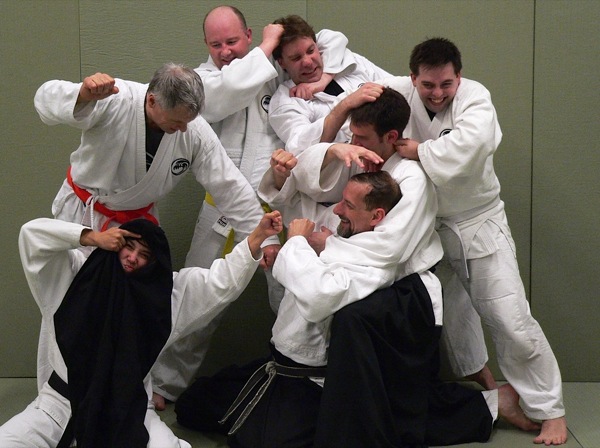
Yes, the title of this blog post says it all. I managed to tear a huge whole in the rear end of my new Century gi pants while I performed a Ganseki Otoshi during our guest instructor class with Andy Dobie Sensei of Jitsu Canda. It’s not like they’re cheap pants either. They’re the 10-oz cotton pants, so the material is reasonably robust. As you can see from our goofy class photo, the tear in my pants was big enough for me to fit my face through it. The hole was huge!
4 Ways to Increase Resistance in Your Self-Defense Training
 Learning to apply martial arts techniques for self-defense purposes is a large part of what we do in our dojo. What we teach is not intended to be a purely theoretical practice, but rather a system of techniques with real world applications should a bad situation go down and you’re forced to defend yourself physically.
One problem with training realistic self-defense techniques is that it isn’t safe to practice many of the techniques we teach full tilt. At the same time, you don’t want to lull yourself into thinking that practising techniques on a compliant partner is enough to train you for what to expect in a real physical attack. As you become more familiar with techniques and how to apply them, students should start practising them against partners exerting more and more resistance so as to increase the realism of their training. Here are my thoughts on how to do this: (more…)
5 Awesome Judo Videos
A martial art derived from Jiu-jitsu, Judo shows beautifully on film. Some of my favourite YouTube videos featuring martial arts are of Judo. As a bit of a lighter post today, I figured I share a few of my favourites.
This first video is a demo that was put on at a festival celebrating the sport, performed by two Olympic-level Judoka. Their core strength is awe-inspiring as they demonstrate Judo throws in slow motion (both forward and in reverse). Also LOVED the Jedi-style throwing from a distance (which can only be seen to be understood). Have a watch: (more…)
How to Make the Most of Being Laid Off
 When I was growing up, I never knew any adults who were laid off or lost their jobs. My parents both had stable jobs for the government and were never laid off even once in their entire careers. Boy, was I in for a shock when I entered the full-time work world myself. When I first started my adult working life, I began with a full-time career in marketing. Since then, I got laid off 3 times in 4 years as poor economies induced cutbacks in companies I worked for.
The first time I was laid off, I was devastated, but since then I’ve learned that being laid off can be a wonderful life-changing experience if you approach it the right way. Below are some tips for getting the most out of lay-offs. (more…)
Balance Breaking Games for Martial Arts Training
Balance, stance and structure are all important concepts in the martial arts. When you take your attacker’s balance, shift them out of their stance and compromise their structure, you can more easily throw them, take them to the ground, draw them into locks/submissions, etc. Conversely, by maintaining strong stance and structure, you apply locks, throws, strikes, etc with greater efficiency making them easier to apply with less effort.
One way we like to emphasize these concepts in our classes is by playing balance breaking games in stances like horse stance and forward stance. These help students understand the give and take of balance stance and structure and its relevance to the martial arts. Watch the video below to see how we play these games. (more…)
The Story Behind Our Logo & Branding
When I first founded our dojo, I wanted to establish a brand that expressed the true nature of what we offer. We are what I call a “modern traditional” style of Japanese Jiu-jitsu with a Canadian influence. We don’t have current links to Japan, nor do we have a heavy Japanese influence, but we do uphold many of the original ideals.

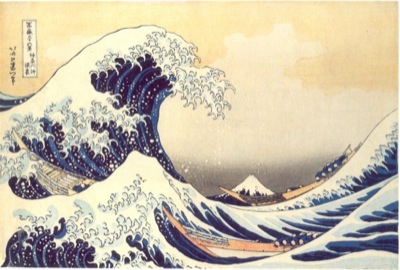 The logo I created was inspired by Hokusai Katsushika’s painting, ”The Great Wave Off Kanagawa’ created in the 1830s (seen here on the left). It symbolizes how something as soft and flexible as water can generate great power, as with the ideals of Jiu-jitsu. It is also styled to be a yin-yang, symbolizing the ‘give and take’ embodied in eastern martial arts training and philosophy. The orange used in combination with our logo symbolizes the setting sun of the west coast, alluding to the Canadian influence of our style. (more…)


 We're proud to announce that Lori O'Connell Sensei's new book, When the Fight Goes to the Ground: Jiu-jitsu Strategies & Tactics for Self-Defense, published through international martial arts publisher Tuttle Publishing, is now available in major book stores and online. More about it & where to buy it.